

Skowronno Reserve
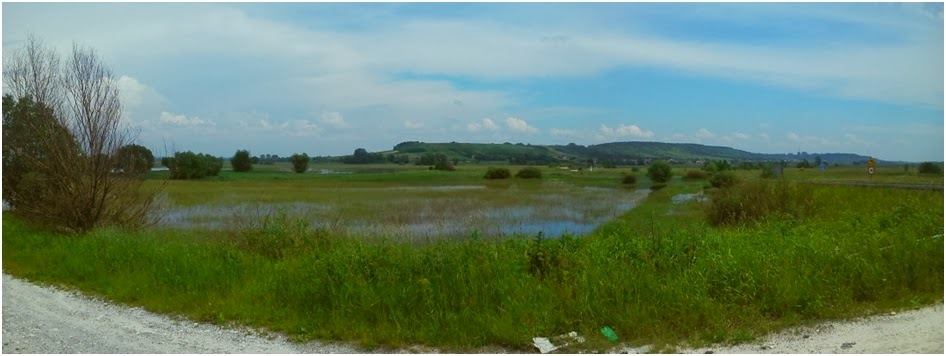
The “Skowronno” reserve is located in an extremely picturesque place – at the northern end of the Pińczów Upland, rising over 50 meters above the Nida valley. The main subject of its protection is fragments of steppe grasslands. The Skowronno reserve lies within the boundaries of the Nadnidziański Landscape Park, the Special Protection Area Nidziańska Refuge, and in close proximity to the Special Protection Area Natura 2000 Nida Valley. On the plateau of the Pińczów Upland, about 2 km from the “Skowronno” reserve, it is proposed to establish (according to the current municipality study) the “Pińczowskie Mountains” nature reserve (also known as “Serpentyny”). The reserve is expected to encompass the area of the Skowronno deposit, an inactive deep-slope quarry of Pińczów limestone, overgrown with grass and with scattered trees, along with exposures of lithothamnion limestone. In the area adjacent to the deposit, the expansion of steppe vegetation of the narrow-leaved butterbur community has been observed. Within the reserve and its vicinity, there are several interesting and never thoroughly examined archaeological sites.
Within its boundaries, a limestone quarry extracting Pińczów limestone operated as early as the 11th century. This is the oldest excavation for this famous stone among all the quarries around Pińczów, and its operation lasted continuously for about 100 years. The stone extracted from this very place was used for construction here, such as details in the church in Kije (details and facing blocks), in the collegiate church in Skalbmierz (towers and foundations of the walls), as the building material for the church founded by Jan Długosz in Chotlu Czerwonym, and possibly also in the churches in Imielno and Mokrsk near Jędrzejów and the church for the Knights Hospitaller in Zagoście.
The village located at the foot of the slope “Skowronno Dolne” has a long history – its origins date back to the 11th century. Until recently, there was a manor built in the 17th century in the village. The manor was situated directly by the road encircling the hill where the nature reserve was established. Since there is no trace left of the manor, it is suspected that its ruins were used to reconstruct the road to Pińczów. The manor, also built from local material – Pińczów limestone, would have made a beautiful showcase for the area. Many other objects listed in the register of monuments shared the fate of the manor. Of the eleven objects, only one remains – a brick school from 1934. Fortunately, roadside and floodplain figures have survived – a permanent and valuable element characteristic of the Ponidzie region. These so-called small sacral architecture objects date back to the 18th and 19th centuries and are the work of stone workshops from Pińczów. By the dirt road, on the slope right by the border of the reserve, stands the first – a statue of St. Agatha, the patron of good work. Lower down, at the road connecting the villages of Skowronno Dolne and Skowronno Górne – the second statue of St. Florian – prevents fires, and the third - St. John of Nepomuk – placed for protection against floods. At the foot of the mountain, there is another interesting historical object – linear – Ciuchcia Expres Ponidzie. The narrow-gauge railway, built in the 1920s, has been restored and is currently used for tourism purposes. It should be remembered that the reserve has outstanding landscape values, even though it has not been classified as such. The conditions resulting from the unique location of the reserve, in the natural and cultural context, predispose it to be included in systematic planning. The issue of protecting xerothermic grasslands of Ponidzie has not been addressed here. This constitutes a separate, equally important problem that goes beyond the framework of local planning.
From Pińczów, a nature-geological educational trail runs through the northwestern part of the Pińczów Upland to the village of Skowronno Górne. Its length is 7 km. Along its route, there are 11 stops (viewpoints, exposure of Pińczów limestone in an inactive quarry, a sandpit, patches of xerothermic vegetation, forest and field ecosystems, and the Skowronno reserve).
The subject of protection of the reserve is a fragment of xerothermic grasslands with numerous species of protected and endangered plants, such as: June grass, steppe viper's bugloss, hairy feather grass, spring adonis, large-flowered anemone, small reseda, or common primrose. The fauna of the reserve is represented by an entomofauna associated with xerothermic grasslands. Among the rare fauna present in the reserve are beetles: the weevil Rhynchites aethiops and the click beetle Longitarsus minimus.
Interesting fact: the nearby Pińczów Building Stone Plant partially constructed the Palace of Culture and Science. Unfortunately, the plant no longer exists.
Author of the text and photos - Michał Podlach