

Roztocze

Roztocze – a land of forests, hills and rushing rivers
Where nature meets history
Roztocze is one of Poland’s most picturesque and, at the same time, most diverse tourist regions. It stretches in a broad belt from the area around Kraśnik in the Lublin region to Lviv in Ukraine, forming a unique ridge of uplands separating the Lublin Upland from the Sandomierz Basin. In Poland, it mainly covers the south-eastern part of Lublin Voivodeship and the north-eastern areas of Podkarpackie Voivodeship. Here, extensive forests, rolling landscapes, crystal-clear rivers and small towns create scenery quite unlike that of any other region in the country.
For years, Roztocze has attracted people seeking peace, contact with nature and active relaxation away from crowded resorts. There are no high mountains or vast lakes such as those known from Masuria, but the region delights visitors with something far more valuable – harmony of the landscape, exceptional natural richness and authenticity. It is a place where you can cover dozens of kilometres of forest trails, discover charming river valleys, admire wooden Orthodox churches, visit small villages preserving their former character and listen to the murmur of streams flowing over limestone thresholds.
Exceptional geographical location
Roztocze is a geographical mesoregion approximately 180 kilometres long. A considerable part lies in Poland, while the remainder runs through western Ukraine as far as the area around Lviv. The region forms a distinctive belt of uplands built mainly of limestone, opoka and Cretaceous sandstone, giving the landscape its gentle hills, extensive forests and deeply incised river valleys.
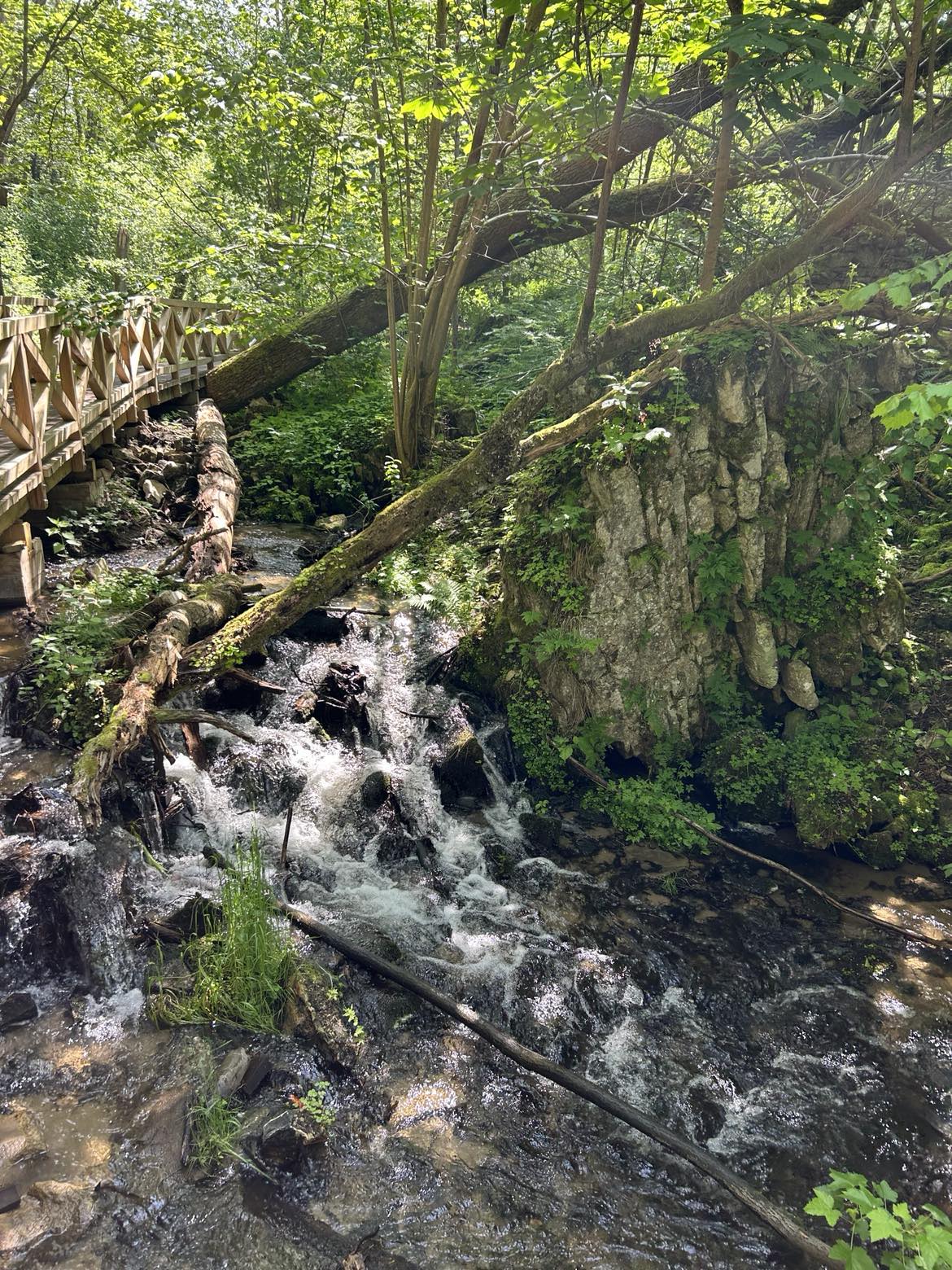
The highest elevations in the Polish part of Roztocze exceed 390 metres above sea level, but it is not altitude that determines the region’s appeal. Its uniqueness lies in its exceptionally varied relief, numerous springs, picturesque river gorges and characteristic limestone thresholds, where small waterfalls known as ‘szumy’ are formed. These have become one of the symbols of Roztocze and are among the region’s most frequently photographed attractions.
Roztocze is also an important European watershed. Rivers belonging to two great drainage basins – the Vistula and the Dniester – have their sources or upper sections here. As a result, the region has played an important natural and economic role for centuries, while also preserving many valuable natural habitats.
A land of extraordinary nature
Nature is Roztocze’s greatest treasure. Much of the region is covered by extensive forest complexes, dominated by pine forests, beech woods and fir forests. The Roztocze National Park is a particularly valuable area, protecting some of the best-preserved forest ecosystems in this part of Europe. Here it is possible to encounter Polish Konik horses – descendants of the tarpan – as well as deer, roe deer, wild boar, badgers and numerous species of birds of prey.
No less impressive is the Solska Forest, one of the largest continuous forest complexes in Poland. It is a land of wild nature, peat bogs, woodland ponds and rare plant species. Together with Roztocze National Park, it forms an exceptionally valuable ecological corridor that plays an important role in protecting Europe’s biodiversity.
Roztocze is captivating in every season. In spring, the forests are covered with carpets of flowering plants; in summer, the region attracts walkers and cyclists; in autumn, it delights visitors with the riot of colour in its beech woods; while in winter, it becomes a peaceful place to escape the bustle of the city.
Borderland history
For centuries, Roztocze was a place where cultures, religions and traditions mingled. Important trade routes linking western and eastern Europe crossed the region, while Poles, Ruthenians, Jews, Armenians and representatives of other nationalities lived together in its towns and villages for centuries. The legacy of this multiculturalism can still be seen in the architecture, urban layouts, historic places of worship and local customs.
Over the centuries, Roztocze witnessed many important historical events – from the foundation of royal towns and the development of the Zamość Estate, through the wars of the seventeenth century, to the dramatic events of the Second World War. Numerous partisan units operated in the forests of Roztocze, and many places still commemorate the heroes who fought for Poland’s independence.
It is no coincidence that the region is also called a borderland. Western and eastern cultural influences meet here, perfectly illustrated by wooden Orthodox churches, historic churches, roadside shrines and former cemeteries of different denominations. All this makes Roztocze fascinating not only to nature lovers, but also to people interested in history and cultural heritage.
Why is Roztocze so captivating?
At a time when many popular tourist regions struggle with excessive visitor numbers, Roztocze remains a place where silence and genuine contact with nature can still be found. It is ideal for a day trip, a weekend break or a holiday lasting several weeks and filled with active recreation.
Within a relatively small area lie some of Poland’s most beautiful walking and cycling trails, picturesque river valleys, famous cascades, historic towns, quarries, nature reserves and sites of great historical importance. Everyone can find something here – families with children, cyclists, photographers, canoeists, nature lovers, history enthusiasts and people seeking peaceful relaxation away from metropolitan bustle.
Roztocze does not try to impress visitors with spectacular peaks or huge resorts. Its greatest strength is its extraordinary diversity and an atmosphere that is difficult to find anywhere else in Poland. Here, nature, history and culture have formed a harmonious whole for centuries, making every journey a unique experience.

Roztocze’s greatest attractions – places not to be missed
Roztocze delights visitors with an extraordinary variety of attractions. Within a relatively small area there are picturesque towns, extensive forests, nature reserves, famous cascades, architectural monuments, viewpoints and some of Poland’s finest cycling routes. It is a region that can be explored over many days, with each successive locality revealing a completely different side of its character.
Below are the places worth including when planning a trip around Roztocze.
Zwierzyniec – the tourist heart of Roztocze
Zwierzyniec has long been regarded as the unofficial capital of Roztocze and one of the region’s most beautiful towns. Situated on the edge of Roztocze National Park, it charms visitors with its peaceful atmosphere, extensive green areas and exceptional combination of natural and historical attractions.
The town’s most recognisable symbol is the Baroque Church of St John of Nepomuk, picturesquely situated on an island among ponds. It is also worth visiting the historic Zwierzyniec Brewery, the Environmental Park and Echo Ponds, where visitors can relax on a sandy beach and observe Polish Konik horses living in a special refuge.
Zwierzyniec is also an excellent base for exploring the whole region – many walking, cycling and educational trails through Roztocze National Park begin here.
Krasnobród – a spa town full of attractions
Krasnobród is one of Roztocze’s most popular holiday destinations. For years, the town has attracted tourists with its picturesque reservoir, extensive forests and favourable microclimate, and it also serves as a health resort.
The greatest attraction is the Sanctuary of the Visitation of the Blessed Virgin Mary, with its Baroque monastery complex, and the famous Chapel ‘At the Water’, associated with the legend of an apparition of the Virgin Mary. In summer, the reservoir with its sandy beach, water-sports hire facilities and numerous walking routes is particularly popular.
Active visitors can enjoy walking, cycling and skiing trails, while the nearby hills offer beautiful panoramas of Roztocze.
Susiec – a land of cascades and forest walks
Susiec is one of the best places for people wishing to relax surrounded by nature. The most popular trail to the famous Tanew Cascades – a series of small waterfalls formed on the river’s rocky thresholds – begins here.
In addition to its exceptional natural attractions, Susiec offers numerous walking paths, cycling routes and convenient accommodation. The surrounding forests are among the most picturesque parts of Roztocze and are beautiful at every time of year.
Józefów – quarries and Roztocze panoramas
Józefów is known above all for its former limestone quarries, which today are among the region’s most characteristic attractions. A walk between the high quarry walls reveals Roztocze’s geological history, while the nearby observation tower offers a broad panorama of the surrounding forests and hills.
The town is also an excellent base for visiting the Solska Forest, Czartowe Pole Nature Reserve and numerous walking and cycling trails.
Szczebrzeszyn – more than just a beetle
Although Szczebrzeszyn is mainly associated with Poland’s most famous tongue-twister, the town has much more to offer. Its history dates back to the Middle Ages, and its multicultural heritage can be seen in monuments such as St Nicholas’ Church, the Orthodox Church of the Dormition of the Blessed Virgin Mary and the former synagogue.
A walk through the historic centre reveals the town’s rich history, while the beetle monument remains an obligatory stop and one of Roztocze’s best-known symbols.
Tomaszów Lubelski – the gateway to Roztocze
Situated on the south-eastern edge of the region, Tomaszów Lubelski is an excellent base for exploring Roztocze and the Solska Forest. In the town, it is worth seeing the historic Church of the Annunciation of the Blessed Virgin Mary and the former Church of St Nicholas, as well as learning about Dr Janusz Peter, an outstanding physician and social activist associated with Tomaszów.
The surrounding area offers numerous trails leading to nature reserves, viewpoints and picturesque river valleys.
Guciów – an open-air museum and Roztocze tradition
The small village of Guciów is one of the most atmospheric places in Roztocze. It is home to the well-known Guciów Homestead, a private open-air museum presenting the traditional architecture, culture and everyday life of the region’s former inhabitants.
It is an excellent place to learn about the history of Roztocze, sample local dishes and see what everyday life in this area looked like several decades ago.
Narol and Horyniec-Zdrój – Roztocze’s eastern face
The less frequently visited part of Roztocze conceals many remarkable places. Narol delights visitors with the Łos’ Palace and the peaceful atmosphere of a small town, while Horyniec-Zdrój has long been known as a health resort famous for its medicinal mineral waters and therapeutic peat.
The surrounding forests, Orthodox churches and borderland landscapes reveal a lesser-known but extremely interesting face of the region.
Roztocze National Park – the natural heart of Roztocze
Roztocze National Park is one of Poland’s most valuable protected areas and undoubtedly the greatest natural attraction of Roztocze. Established in 1974, the park covers more than 8,400 hectares of forests, river valleys, peat bogs and hills, protecting unique ecosystems characteristic of this part of the country. It is a place where nature has developed for decades with almost no human interference, allowing visitors to admire some of the best-preserved forests of the Lublin Upland.
The park lies in the central part of Roztocze, with Zwierzyniec serving as its natural gateway and an excellent base for exploring the most interesting corners of this exceptional area.

A kingdom of beeches, firs and ancient forests
The greatest wealth of Roztocze National Park is its extensive forests, which cover more than 95% of its area. Carpathian beech woods, fir forests and mixed woodland dominate here, with some areas retaining an almost natural character. In many places, visitors can admire huge beeches, firs and pines several hundred years old, creating the extraordinary atmosphere of ancient forests.
Numerous streams and the Wieprz River flow through the park. Its upper, spring-fed sections are among the cleanest in Poland. Picturesque river valleys, woodland ponds and wet meadows create ideal living conditions for many rare species of plants and animals.
Polish Konik horses – a symbol of Roztocze
The park’s best-known inhabitants are Polish Konik horses, descendants of the tarpan, a wild horse that once lived in European forests. The animals are kept in a conservation breeding programme near Echo Ponds, where visitors can observe them in conditions close to natural ones.
Polish Konik horses have consequently become one of Roztocze’s symbols and attract thousands of visitors to the park every year.
Other inhabitants of Roztocze National Park include deer, roe deer, wild boar, foxes, badgers, beavers and numerous bird species, including lesser spotted eagles, black storks and black woodpeckers. This wealth of wildlife makes the park a true paradise for nature photographers and birdwatchers.
The most beautiful places in Roztocze National Park
It is best to begin exploring the park in Zwierzyniec, from where most tourist trails lead. One of the most popular places is Echo Ponds, a picturesque complex of water bodies surrounded by forests. In summer there is a bathing area with a sandy beach, while throughout the year visitors can walk along paths around the ponds.
Bukowa Góra is also very popular, offering broad views of Roztocze’s forests. The educational path leading to the summit introduces visitors to characteristic plant species and the history of the local forests.
It is also worth visiting Florianka, a former forest settlement with historic buildings belonging to the Zamość Estate and a Polish Konik breeding centre. The site illustrates the history of land management in Roztocze and the relationship between people and the surrounding natural environment.
A paradise for active recreation
Roztocze National Park offers dozens of kilometres of marked walking and cycling trails leading through the region’s most beautiful areas. The routes are relatively easy and accessible to people of varying fitness levels, which is why the park is popular with families and beginner hikers.
The park is also crossed by the Central Roztocze Cycling Trail and part of the popular Green Velo route, making it one of the most important cycling destinations in eastern Poland.
The Solska Forest – Roztocze’s wild heart
The Solska Forest is one of the largest and best-preserved forest complexes in Poland, occupying the southern part of Roztocze and part of the Sandomierz Basin. Extensive pine forests, fir and beech woods, peat bogs, woodland marshes and numerous river valleys create a landscape that has served as a refuge for wild nature for centuries. Here, visitors can experience a degree of silence that is increasingly difficult to find in popular tourist regions.
Although the Solska Forest is not as famous as the Białowieża or Tuchola Forests, many nature lovers consider it one of the most valuable places in eastern Poland. Extensive forests, small villages and limited development have allowed the region to retain its natural character and unique atmosphere.
A land of forests, rivers and peat bogs
The greatest wealth of the Solska Forest is its extensive woodland, which in places stretches for dozens of kilometres. Pine forests dominate, but firs, beeches, oaks, alders and spruces also grow here. Valuable peat bogs and wet meadows have survived in depressions, providing habitats for many rare species of plants and animals.
Picturesque rivers, including the Tanew, Sopot and Szum, flow through the forest. Their crystal-clear waters form numerous rocky thresholds and small waterfalls. These are the famous cascades, one of the most characteristic features of Roztocze’s landscape.
A refuge for wild nature
The Solska Forest is a true paradise for nature lovers. Deer, roe deer, wild boar, foxes, badgers, beavers and wolves live in its extensive forests, with wolves having appeared increasingly often in recent years. Lynx can also be found here, although they are among the forest’s most elusive inhabitants.
The rich birdlife includes black storks, cranes, lesser spotted eagles, eagle owls and numerous species of woodpecker. Thanks to its vast woodland and limited human interference, the Solska Forest remains one of the most important nature conservation areas in this part of Europe.
The most interesting places in the Solska Forest
Exploration of the Solska Forest is best begun around Józefów and Susiec, from where numerous walking and cycling trails lead. One of the most popular sites is the Czartowe Pole Nature Reserve, where the Sopot River forms a picturesque valley with numerous rocky thresholds and the remains of a former paper mill.
Another extraordinary attraction is the Tanew Cascades, regarded as one of Roztocze’s most beautiful natural phenomena. Dozens of small cascades stretching along the river create scenery reminiscent of mountain streams, despite the fact that this is an upland area.
It is also worth visiting the quarries in Józefów, numerous educational trails and viewpoints scattered throughout the region. Each of these places offers a different perspective on the Solska Forest.
Cascades, waterfalls and rivers – Roztocze’s greatest natural treasures
One of the most characteristic features of Roztocze’s landscape is the ‘szumy’ – small waterfalls and cascades formed on limestone and sandstone river thresholds. Although they are not high, they are exceptionally charming and are among the region’s best-known attractions. The sound of running water, the surrounding forests and almost untouched nature have attracted tourists, photographers and walkers for years.
Roztocze is often compared with mountainous regions because of these cascades, even though its highest elevations do not exceed 400 metres above sea level. A walk along the forest streams reveals how extraordinarily varied the landscape of south-eastern Poland can be.
Tanew Cascades – a symbol of Roztocze
The region’s best-known natural attraction is the Tanew Cascades, located between Susiec and Rebizanty. Over several kilometres, the Tanew River passes over numerous rocky thresholds, forming more than twenty small cascades. Each is only a few dozen centimetres high, but together they create a remarkably picturesque landscape that has become one of Roztocze’s symbols.
Wooden footbridges, forest paths and well-prepared facilities make the area convenient to explore during either a short walk or a full-day excursion. It is particularly beautiful in spring, when water levels are highest, and in autumn, when colourful leaves create an extraordinary setting.
Czartowe Pole – where history meets nature
One of Roztocze’s most atmospheric places is the Czartowe Pole Nature Reserve, situated in the Sopot River valley. Water flowing over numerous rocky thresholds forms picturesque rapids and small waterfalls, while dense forests of the Solska Forest surround the whole area.
The walk is enhanced by the remains of an eighteenth-century paper mill, recalling the industrial history of the site. The combination of nature and historic remains makes Czartowe Pole one of Poland’s most interesting nature reserves.
The most beautiful walking trails of Roztocze
Roztocze is one of Poland’s finest regions for walking. Gentle hills, extensive forests, numerous nature reserves and well-marked routes make the trails accessible both to beginners and to experienced hikers. Unlike mountain ranges, they do not require excellent fitness, while still offering exceptionally varied scenery.
One of the best-known routes leads to Bukowa Góra. The path passes through some of the finest parts of Roztocze National Park and reveals natural beech and fir forests. A broad panorama of the surrounding hills and forests extends from the summit. The route is relatively short and easy, making it suitable for families with children.
Roztocze cycling routes – a paradise for two-wheel enthusiasts
Roztocze has long been regarded as one of Poland’s best cycling regions. Gentle hills, little motor traffic, extensive forests and a well-prepared network of routes make it possible to discover almost every corner of the region by bicycle. The bike is the best way to experience Roztocze’s diversity – from peaceful river valleys and picturesque hills to small towns and nature reserves hidden in the forests.
Green Velo – Poland’s most famous cycling trail
The best-known route through Roztocze is Green Velo, the Eastern Cycling Trail, almost 1,900 kilometres long. In the Roztocze section it passes through some of the region’s finest landscapes, linking Zwierzyniec, Józefów, Susiec and the area around Tomaszów Lubelski.
Along the way, cyclists can visit Roztocze National Park, Echo Ponds, the Józefów quarries, the Tanew Cascades and numerous viewpoints. The route is well signposted and equipped with Cyclist Service Areas, making it suitable for multi-day trips.
Roztocze viewpoints
Roztocze does not offer the high peaks characteristic of the Carpathians or Sudetes, but its rolling terrain provides many places from which to admire broad panoramas of forests, fields, river valleys and small towns. Hills, observation towers and natural viewpoints reveal the region from a different perspective and demonstrate the diversity of its landscape.
The Józefów observation tower
One of the region’s best-known viewpoints is the observation tower in Józefów, located on Kamienna Góra. The approximately 19-metre-high structure was built in 2015 and quickly became one of the greatest attractions in this part of Roztocze.
The viewing platform offers a broad panorama of the Solska Forest, the rolling terrain of Roztocze and the area around Józefów. In clear weather, the distant hills of Central Roztocze can also be seen.
Roztocze’s monuments and cultural heritage
Roztocze is not only forests, cascades and picturesque landscapes. For centuries, the region was a meeting place of different cultures, religions and nationalities. Poles, Ruthenians, Jews, Armenians and Germans lived alongside one another here, leaving a rich architectural and cultural heritage. Historic churches, Orthodox churches, synagogues, cemeteries and town layouts still bear witness to the special character of this borderland.
Wooden Orthodox churches – a unique borderland heritage
Among Roztocze’s most characteristic cultural features are its wooden Orthodox churches, witnesses to the centuries-old presence of Ruthenian and Greek Catholic communities. Built of wood, often without nails, they blend perfectly into the surrounding landscape. Many still contain valuable iconostases, polychrome paintings and liturgical furnishings.
Among the most valuable are the churches in Radruż, Gorajec, Nowe Brusno and Chotyniec. The Radruż church, on the border between Roztocze and the Lubaczów Land, is inscribed on the UNESCO World Heritage List. These buildings form an important part of the Wooden Architecture Trail and attract lovers of history and sacred art from across Europe.
Roztocze cuisine – flavours of the borderland
Roztocze delights not only with its landscapes and natural wealth, but also with its distinctive cuisine, shaped by centuries of cultural interaction. Polish, Ruthenian, Ukrainian, Jewish and Armenian culinary traditions met here, producing simple, filling food based on local products and seasonal ingredients.
Potatoes, groats, flour, cabbage, mushrooms and produce from the surrounding forests and fields play a major role. Honey, cheese, freshwater fish and wild berries are also important. Although many dishes originated in peasant cuisine, today they are among the region’s greatest culinary attractions.
Pierogi – a symbol of Roztocze cuisine
One of the most characteristic dishes is, of course, pierogi, prepared according to local recipes passed down from generation to generation. Depending on the locality, fillings range from potatoes and curd cheese, through cabbage and mushrooms, to seasonal blueberry or plum fillings.
Why visit Roztocze?
Roztocze does not try to impress tourists with spectacular attractions or huge resorts. Its greatest strength is authenticity. Here, nature has coexisted with history for centuries, while peaceful towns and villages have retained their unique character. At a time when many popular destinations struggle with excessive visitor numbers, Roztocze remains a place where it is genuinely possible to relax.
Here you can begin the day with a walk through the beech forests of Roztocze National Park, admire the Tanew Cascades at midday, discover the monuments of Zwierzyniec or Krasnobród in the afternoon and enjoy regional dishes in the evening, prepared according to recipes passed down through generations. Few regions in Poland offer such a harmonious combination of nature, history, culture and active recreation.
Roztocze changes with the seasons. In spring it delights with awakening nature and flowering meadows; in summer it attracts lovers of active recreation; in autumn it enchants with the riot of colour in its beech forests; while in winter it offers a silence that is increasingly difficult to experience elsewhere in Poland.
Roztocze’s greatest treasure, however, is its atmosphere. It is created not by individual attractions, but by the extraordinary combination of nature, landscapes and people who have been connected with the region for generations. It invites visitors to slow down, listen to the sound of rivers, follow a forest trail, pause at a viewpoint and discover Poland’s beauty step by step.
Perhaps that is why so many tourists return. Roztocze is not a region that can be fully discovered in a single visit. Every journey reveals new places, trails, viewpoints and local flavours. It proves that some of Poland’s most beautiful corners are still waiting to be discovered.
If you are looking for a place where you can combine active recreation with contact with nature, learn about the fascinating history of the borderland, sample regional cuisine and relax away from the crowds, Roztocze is one of the best choices. It is a region visited out of curiosity and revisited with the conviction that much remains to be discovered.
A TRIP AROUND ROZTOCZE OR THE LUBLIN REGION? – ORDER ONE FROM US –
Paweł Jamroz
Creator of the MiejscaPolski.pl and OdkryjLubelskie.pl projects. Tour guide and organiser of trips around Poland with many years of experience. For years, he has described towns, regions and monuments, believing that the best journeys begin with a good story. In his writing, he combines history, culture, architecture and the contemporary life of places, creating collections of guidebooks.