

Tarnów
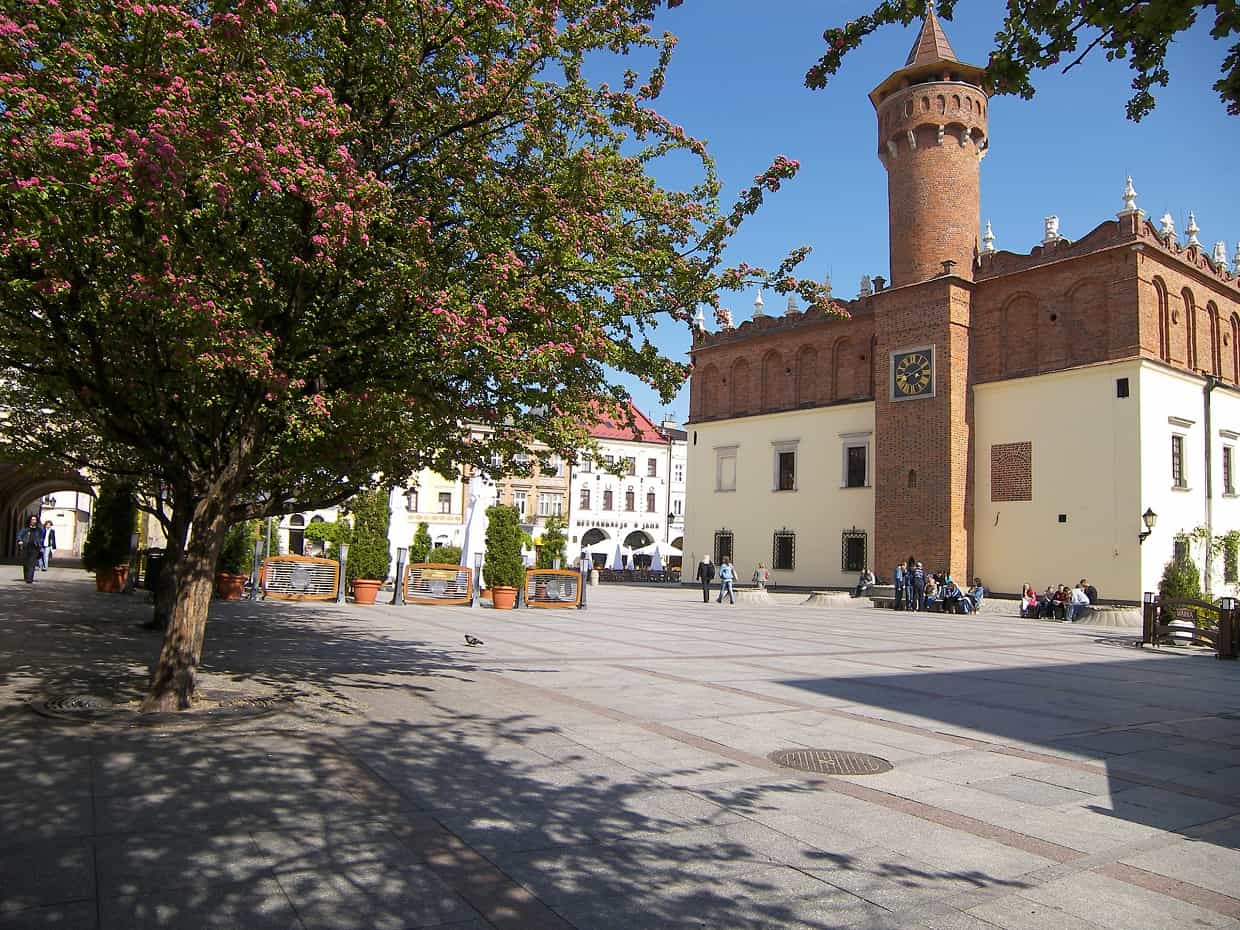
Tarnów - a city in the Małopolska Voivodeship (formerly the capital of the voivodeship before the administrative division). Currently, it has about 110,000 inhabitants. Due to its high average annual temperatures, it is referred to as Poland's "pole of warmth." A city with a rich history and heritage, marked by its distinctive market square and town hall at the forefront. It is an important tourist attraction and an incredibly interesting place in Poland.
The Cathedral
In the Tarnów Cathedral, the most important Tarnów monuments can be found: it is famous for its Renaissance tombs of the Tarnowski family and the Ostrogski family, considered some of the greatest works of art in Poland by masters such as Bartłomiej Berecci, Jan Maria Padovano, and Jan Pfister. The tomb of Barbara Tęczyńska Tarnowska (died 1521) from the workshop of Bartłomiej Berecci is regarded as the most beautiful sculpture depicting a woman of the Renaissance across Europe. Meanwhile, the monumental tomb of Hetman Jan Tarnowski (died 1561) and his son Krzysztof (died 1567) is considered the most monumental in Europe, measuring 13.8 meters in height and 5.6 meters in width.
The Market Square
The Tarnów Old Town, known as the "pearl of Polish Renaissance," is one of the most beautiful examples of Renaissance architectural layout in Polish cities. Currently, the market square is mostly surrounded by two-storey tenement houses presenting various stylistic features of architecture.
In the northern elevation, Renaissance tenement houses with arcades occupied by the District Museum in Tarnów stand out, while a passage built in the early twentieth century stretches along the western elevation all the way to Kazimierz Wielki Square.
The Town Hall
The town hall building currently exhibits characteristics of Renaissance architecture. It is rectangular in shape with a tower to the north and a risalit with a staircase to the south, topped with a brick, unplastered attic featuring twenty-eight blind arches (recesses). The crest of the attic is adorned with stone volutes, finials, and fourteen masks. The 30-meter high tower - square in the lower part (up to the top of the attic) and round in the upper part, with a guardhouse resting on stone corbels, has a sharp roof with a tin coat of arms of the XX Sanguszko family Pogoń Litewska at the top (dating back to the late 18th century, previously topped with the Leliwa of the Tarnowskich). Currently, the Town Hall houses a branch of the District Museum in Tarnów.
The Ethnographic Museum in Tarnów
The museum features the first permanent exhibition in Europe dedicated to the culture and history of the Romani people. The exhibition includes decorative Romani wagons, costumes, and tools. It is worth visiting in the spring or autumn when outdoor Romani performances are organized or at the end of July when the last Romani caravan in Poland sets off on its journey. Dance performances can also be booked.
Jewish Tarnów
Jewish settlers appeared in the area of today's Tarnów region as early as the Middle Ages.
The oldest part of the district once inhabited by Jews comprises Żydowska and Wekslarska streets. The preserved tenement houses from the 17th and 18th centuries demonstrate the specific compact character of Jewish architecture, with narrow passages between tenements, narrow corridors, and tiny courtyards. Characteristic are also the narrow façades, uncommon in the western part of the Old Town. In the door frames, traces of a mezuzah, a scroll of parchment containing fragments of the Torah, can be found. Some houses still have the iron shutters of former Jewish shops.
The Old Synagogue in Tarnów
On Żydowska Street, there is a gate leading to the site where the synagogue stood until World War II. The only preserved fragment of the oldest 17th-century Tarnów synagogue, destroyed by the Germans, is the bima, the platform from which the Torah is read. Since 1996, concerts and artistic performances organized by the Jewish Culture Heritage Committee have been held here as part of the commemoration of the Galician Jews "Galicjaner Sztetl".
Jan Szczepanik - the Polish Edison
Jan Szczepanik is associated with Tarnów as the most versatile Polish inventor. A pioneer of colour photography, television, and colour film, he was a forerunner of modern weaving industry and the bulletproof vest. Born on 13.06.1872 in the Przemyśl area, he was professionally involved with Berlin and Dresden, dying on 08.11.1926 and being buried in Tarnów.
More at:
The text and photos are the property of the Tarnów Information Centre
Photo author: Krzysztof Gzyl